

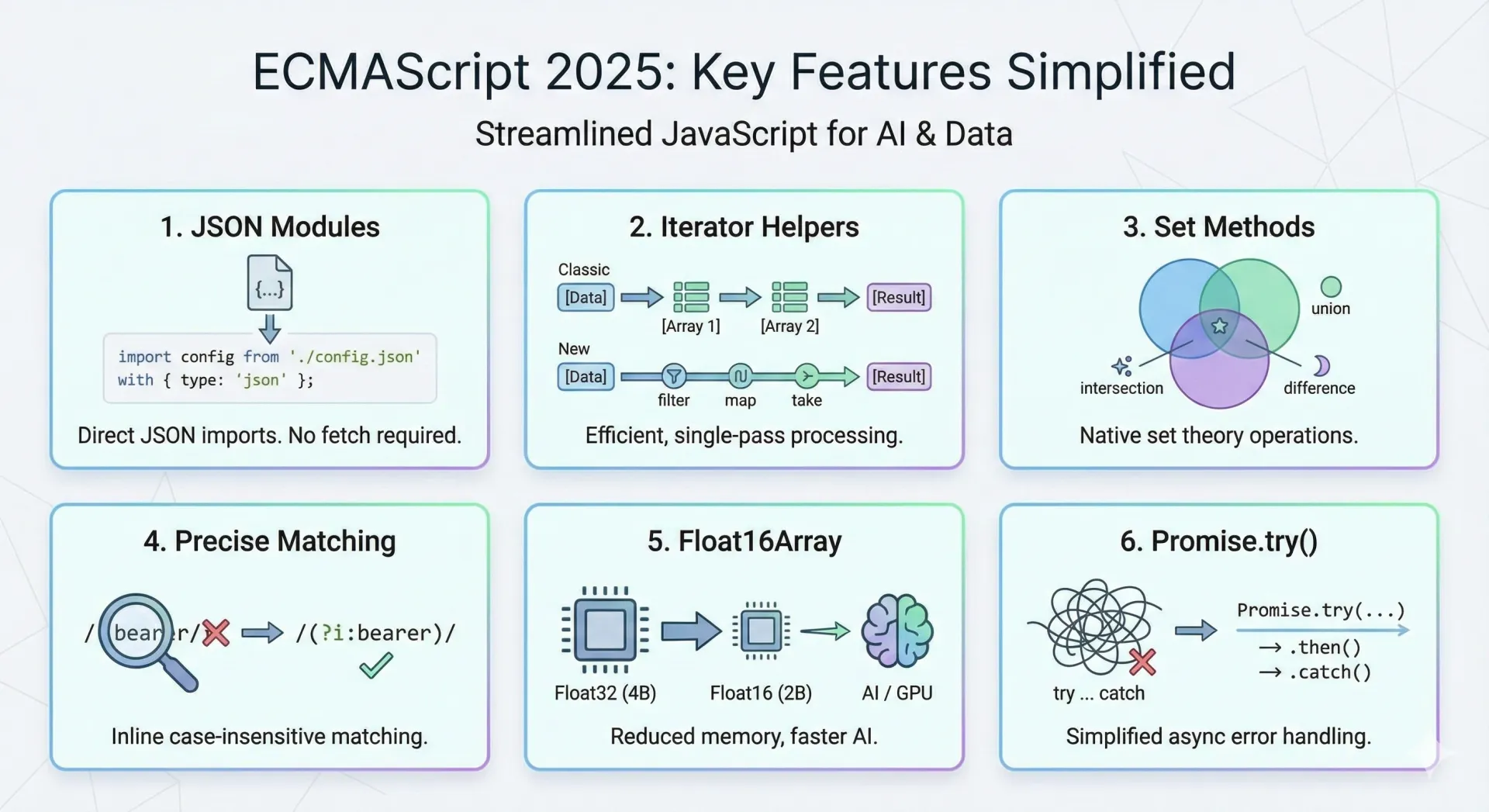
 ES2025 JavaScript Features
Game-Changing ES2025 JavaScript Features
What is ECMAScript 2025?
ECMAScript 2025 (ES2025), the 16th edition of JavaScript, was approved in June 2025. It marks a major evolution of JavaScript from a scripting language to a systems programming environment tailored for AI, WebGPU, and handling massive datasets. These new features empower modern web developers to write cleaner, faster, and more scalable code—perfect for complex Next.js applications, Tailwind CSS integrations, and AI-powered frontends.
1. JSON Modules - No More fetch() Hell
Previously, importing JSON required multiple asynchronous steps:
async function loadAppConfig() {
  const response = await fetch('./appConfig.json');
  const jsonText = await response.text();
  const appConfig = JSON.parse(jsonText);
  return appConfig;
}
With ES2025, you can import JSON modules directly with native support:
import appConfig from './appConfig.json' with { type: 'json' };

console.log(appConfig.apiUrl); // Instant object!
Why it matters: This eliminates verbose boilerplate, enables static imports with tree-shaking benefits, and makes managing config files (like Tailwind config) seamless.
2. Iterator Helpers - Lazy Processing Memory spikes from chaining array methods are common with large datasets:
// Traditional array methods: get doubled odd numbers and slice
const odds = numbers.filter(x => x % 2 !== 0);
const doubled = odds.map(x => x * 2);
const result = doubled.slice(2, 5);
ES2025 introduces iterator helpers allowing lazy, single-pass data processing:
const result = numbers
  .values()
  .filter(x => x % 2 !== 0)
  .map(x => x * 2)
  .drop(2).take(3)
  .toArray();  // example output: [ ... ]
Why it matters: This technique drastically reduces temporary arrays and avoids out-of-memory errors—essential for processing millions of SEO data points in browsers.
3. Set Methods - Native Set Theory
Manipulating sets was previously cumbersome, requiring spreads and filters: const commonUsers = new Set([...users].filter(x => admins.has(x))); ES2025 adds native set operations:
users.intersection(admins);  // Set['jane']
users.union(admins);            // Set['john','jane','bob']
users.difference(admins);    // Set['john']
Why it matters: These pure math methods make code cleaner, faster, and more readable by directly reflecting set theory.
4. Precise Matching
Using global flags like /i often causes unwanted behavior:
text.match(/bearer\s+(abc)/i); // 'i' affects entire pattern
ES2025 introduces inline case control for precise regex matching:
text.match(/(?i:bearer)\s+(abc)/); // Only "bearer" ignores case
Why it matters: Perfect for secure, accurate URL pattern matching and SEO validations without side effects.
5. Float16Array - 2x GPU Speed for AI
AI models benefit from reduced precision for speed and memory savings:
const weights = new Float16Array([1.5, 2.5]);  // 2 bytes per number instead of 4
const buffer = new Float16Array(modelWeights); // Ready for WebGPU
Why it matters: Halve your VRAM usage and get up to 4x faster inference on WebGPU devices—ideal for running small language models (SLMs) directly in the browser.
6. Promise.try() - Unified Error Handling
Before ES2025, error handling with Promises required verbose workarounds:
new Promise((resolve) => resolve(getUserData()))
  .then(saveData).catch(err);

Promise.resolve().then(() => getUserData())
  .then(saveData).catch(err);
Now, you can wrap synchronous/asynchronous functions cleanly:
Promise.try(() => getUserData())
  .then(saveData)
  .catch(err);
Conclusion
ES2025 makes JavaScript simpler, faster, and more powerful. It removes unnecessary boilerplate, improves performance for large data and AI workloads, and adds cleaner ways to write common logic. For modern web apps—especially with Next.js and AI features—these updates help developers write clearer code and build more scalable applications with confidence.