Course Overview
JavaScript is the only language that runs in every browser on earth, which is why almost everyone learns it in the wrong order — a bit of jQuery, a copied snippet, a framework, and a permanent uncertainty about what is actually happening.
This course does it in the right order. Twelve chapters, each one a single idea, starting from what a variable holds and ending with code that talks to a server and handles the three ways that can go wrong. By chapter twelve nothing in a framework tutorial will be unfamiliar, because you will have written the plain-JavaScript version of it first.
No prior programming is required. Some HTML and CSS helps from chapter five onward.
What You’ll Learn
✅ The core language: values, types, conditions, loops, functions, scope.
✅ Data: arrays and objects, and the methods that make working with them short and readable.
✅ The DOM: finding, changing and building page elements from code.
✅ Events: clicks, input, submit, and why the page reloads when you did not want it to.
✅ Modern JavaScript: let/const, arrow functions, destructuring, spread, template literals, modules.
✅ Asynchronous work: callbacks, promises, async/await, fetch, and errors that arrive late.
✅ Debugging: reading a stack trace, using the console and breakpoints, and finding your own bug.
The Chapters
1 — Values and variables. Types, let versus const, what assignment actually copies. You can predict what a variable holds after three lines without running the code.
2 — Making decisions. Truthiness, == versus ===, if, ternaries, switch. You can explain why "5" == 5 is true and why you should not rely on it.
3 — Repeating work. for, while, for…of, and off-by-one errors. You can loop over a list without falling off either end.
4 — Functions. Parameters, return values, scope, hoisting, arrow functions, callbacks. You can take repeated code and turn it into one function used three times.
5 — Arrays and objects. Nesting, references, copying, iteration. You can model a real thing — an order, a customer — as data and reach any part of it.
6 — The DOM. querySelector, text and attributes, creating and removing nodes. You can build a list on the page from an array in your code.
7 — Events. Listeners, the event object, preventDefault, delegation. You can make a form validate without reloading the page.
8 — Modern syntax that earns its place. Destructuring, spread and rest, template literals, default parameters, optional chaining. You can read modern code in the wild and know what each symbol is doing.
9 — Array methods. map, filter, reduce, find, sort, and why they return new arrays. You can transform a list of data into a list of elements in one expression.
10 — Asynchronous JavaScript. The event loop, callbacks, promises, async/await. You can explain why your console.log printed undefined before the data arrived.
11 — Talking to a server. fetch, JSON, status codes, try/catch, loading and error states. You can load live data into a page and handle the request failing.
12 — Organising and shipping. Modules, import/export, a bundler, and debugging with breakpoints. You can split a working script into files and fix a bug you did not write.
Course Highlights
🔥 One idea per chapter — nothing is introduced before the thing it depends on.
🔥 Written by hand first, library second — you write the plain version before you meet the shortcut.
🔥 Debugging is a chapter, not an afterthought.
🔥 Free, including the test and the certificate.
Who Should Enroll?
- Beginners who want the language itself before a framework.
- Web developers who can copy JavaScript but cannot yet change it confidently.
- Front-end and full-stack developers filling the gaps that tutorials skipped.
The Test and Certificate
The exam covers the twelve chapters: scope, coercion, the DOM, array methods, promises and the classic mistakes each one invites. Register, get your hall ticket, sit the timed paper, and pass to earn a certificate with your name, the course and the date.
Sit it now, free: take the practice test for this course. It is scored in your browser and is a self-assessment, not a proctored exam.
Course Duration
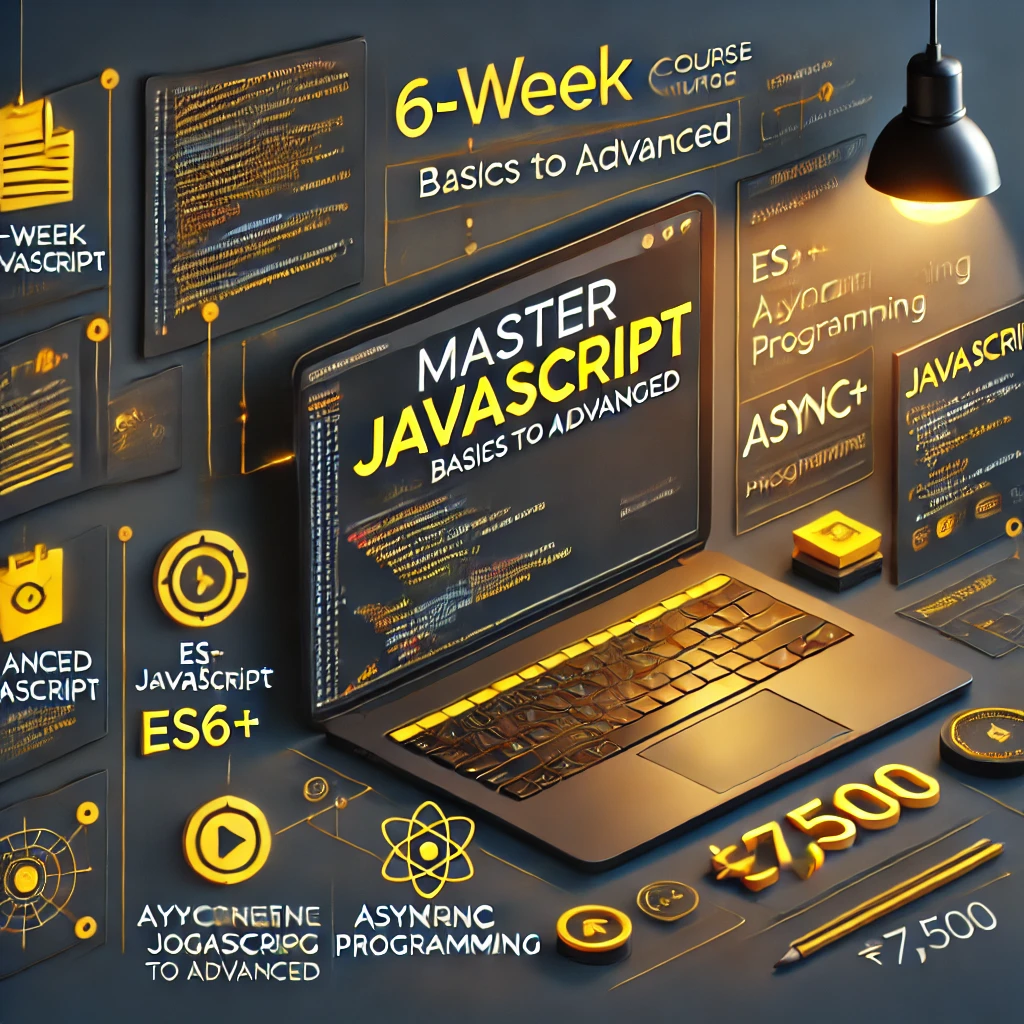
📅 6 weeks, twelve chapters, hands-on. Free.
🚀 Learn the language once, properly, and every framework after it gets easier.
Keywords
free JavaScript course, ES6 training, learn JavaScript, async await tutorial, DOM manipulation, JavaScript for beginners, frontend development, free JavaScript certificate