

Introduction
User Interfaces were traditionally designed with one core assumption: humans do the work.
Users click buttons, fill forms, submit data, and track results. This model worked well for classic applications. However, modern software is rapidly evolving with the introduction of AI agents capable of thinking, planning, and acting independently.
When software starts making decisions and executing tasks on behalf of users, a critical question arises:
How should humans interact with intelligent agents?
This is where A2UI becomes essential.
What Is A2UI?
A2UI stands for Agent-to-User Interface.
It is important to clarify what A2UI is not:
- It is not a frontend framework
- It is not a UI library
- It does not replace React, Vue, or Angular
Instead, A2UI is a UI interaction concept that defines how AI agents and users collaborate through an interface.
In simple terms:
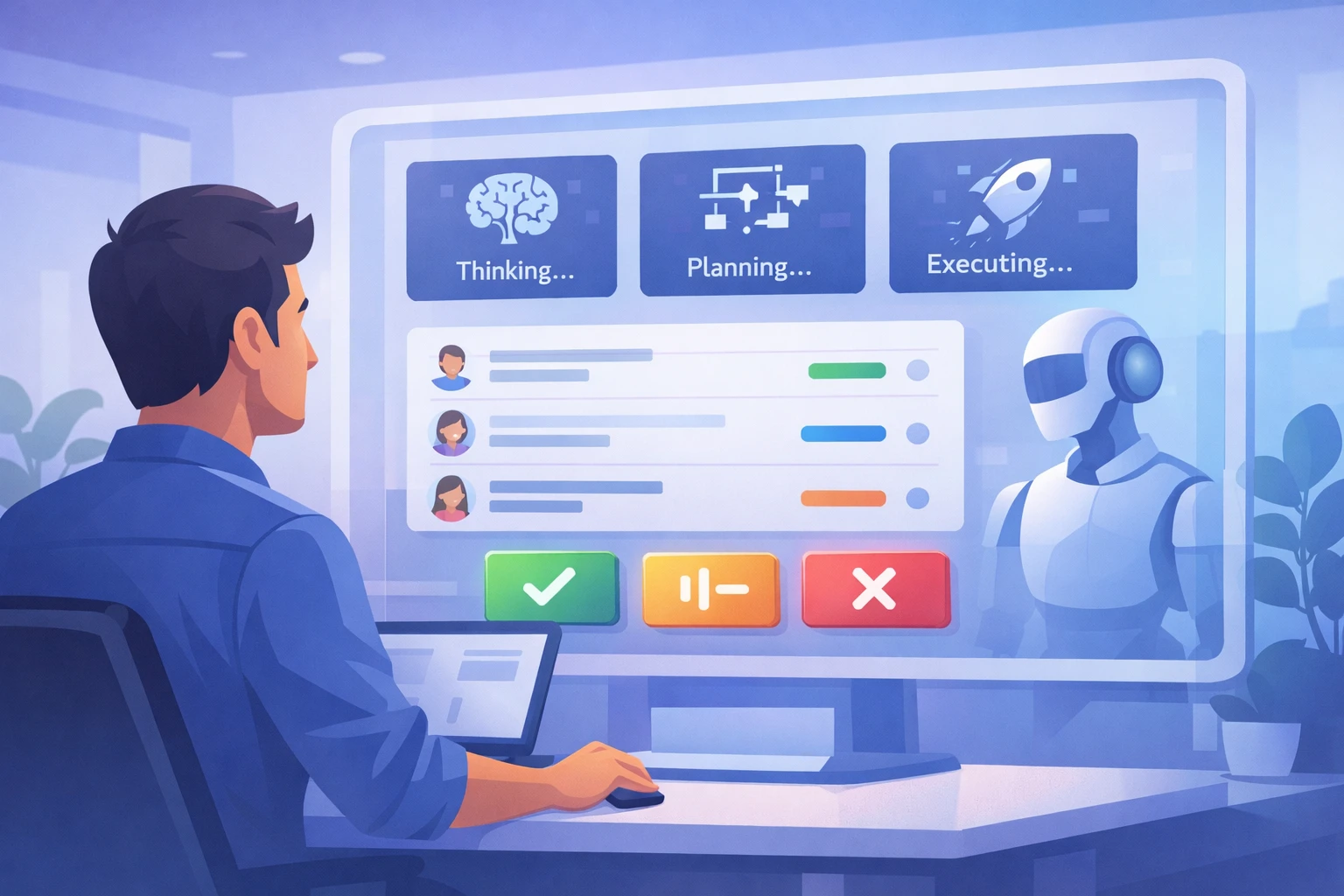
A2UI focuses on how AI agents explain their actions, expose their reasoning, and allow humans to guide or control decisions.
Why Traditional UI Is Not Enough
Traditional UI is built around manual interaction:
- The user knows the steps
- The user executes every action
- The UI only captures input and displays output
This approach breaks down when AI becomes autonomous.
AI agents can:
- Break goals into multiple steps
- Choose tools dynamically
- Execute long-running tasks
- Adapt decisions based on context
If this behavior is hidden behind a single action button, users lose visibility and control. A2UI addresses this gap.
Traditional UI vs A2UI
The difference becomes clear when compared side by side.
| Aspect | Traditional UI | A2UI |
|---|---|---|
| Primary assumption | User performs tasks | Agent performs tasks |
| User input | Step-based actions | Goal-based intent |
| Decision-making | Human | AI agent |
| UI responsibility | Data entry | Explanation and control |
| Transparency | Minimal | High |
| Ideal use case | Manual tools | Agent-driven systems |
A Simple Real-World Example
Traditional UI
A team lead assigns tasks by:
- Opening a task management tool
- Reading requirements
- Manually assigning tasks
- Tracking progress manually
The UI simply stores and displays what the user enters.
A2UI
In an A2UI-based system:
- The team lead provides a goal such as “Assign today’s tasks efficiently.”
- The AI agent analyzes workload and skills
- The agent proposes task assignments
- The UI shows why each decision was made
- The team lead reviews and approves the plan
Here, the UI acts as a bridge between human judgment and agent intelligence.
What Makes an Interface A2UI?
An interface qualifies as A2UI when it provides:
- Clear visibility into agent state (thinking, acting, waiting)
- Step-by-step task planning
- Explanations for agent decisions
- Controls to approve, pause, or modify actions
- Transparency into agent outcomes
Without these elements, the system is automation—not A2UI.
A2UI Is Not Just Automation
This distinction is critical.
Automation UI follows predefined rules and executes fixed workflows.
A2UI, on the other hand, is goal-driven and adaptive. The agent decides how to achieve an outcome, while the human supervises the process.
Automation executes instructions.
A2UI supervises intelligence.
How Developers Implement A2UI
A2UI does not require a special framework.
Developers build A2UI using existing technologies:
- React, Vue, or Angular for the frontend
- Standard backend services
- AI agent orchestration logic
The difference lies in the design approach. Instead of focusing only on inputs and outputs, A2UI emphasizes reasoning, visibility, and control.
When Should Developers Use A2UI?
A2UI is most valuable when:
- Applications rely on AI agents
- Tasks involve multi-step decision-making
- Actions are performed on behalf of users
- Trust and explainability are essential
For simple CRUD applications, traditional UI is sufficient. For agent-driven systems, A2UI becomes a necessity.
Conclusion
A2UI is not about new screens or new frameworks.
It represents a fundamental shift in software interaction:
From users doing the work
to users supervising intelligent agents.
As AI-powered systems continue to evolve, A2UI will play a key role in building transparent, trustworthy, and human-centered applications.
Understanding A2UI today prepares developers for the future of agentic software.