

Introduction
For years, JSON has been the default choice for structured data exchange. APIs, configurations, and integrations across the web rely on it. But with the rapid growth of AI systems and Large Language Models (LLMs), a new requirement has become critical — token efficiency.
Every extra character sent to an LLM consumes tokens. More tokens mean higher cost, slower responses, and reduced context capacity.
This shift has opened the door for a new approach to data representation.
That approach is TOON (Token-Oriented Object Notation).
What is TOON?
TOON stands for Token-Oriented Object Notation.
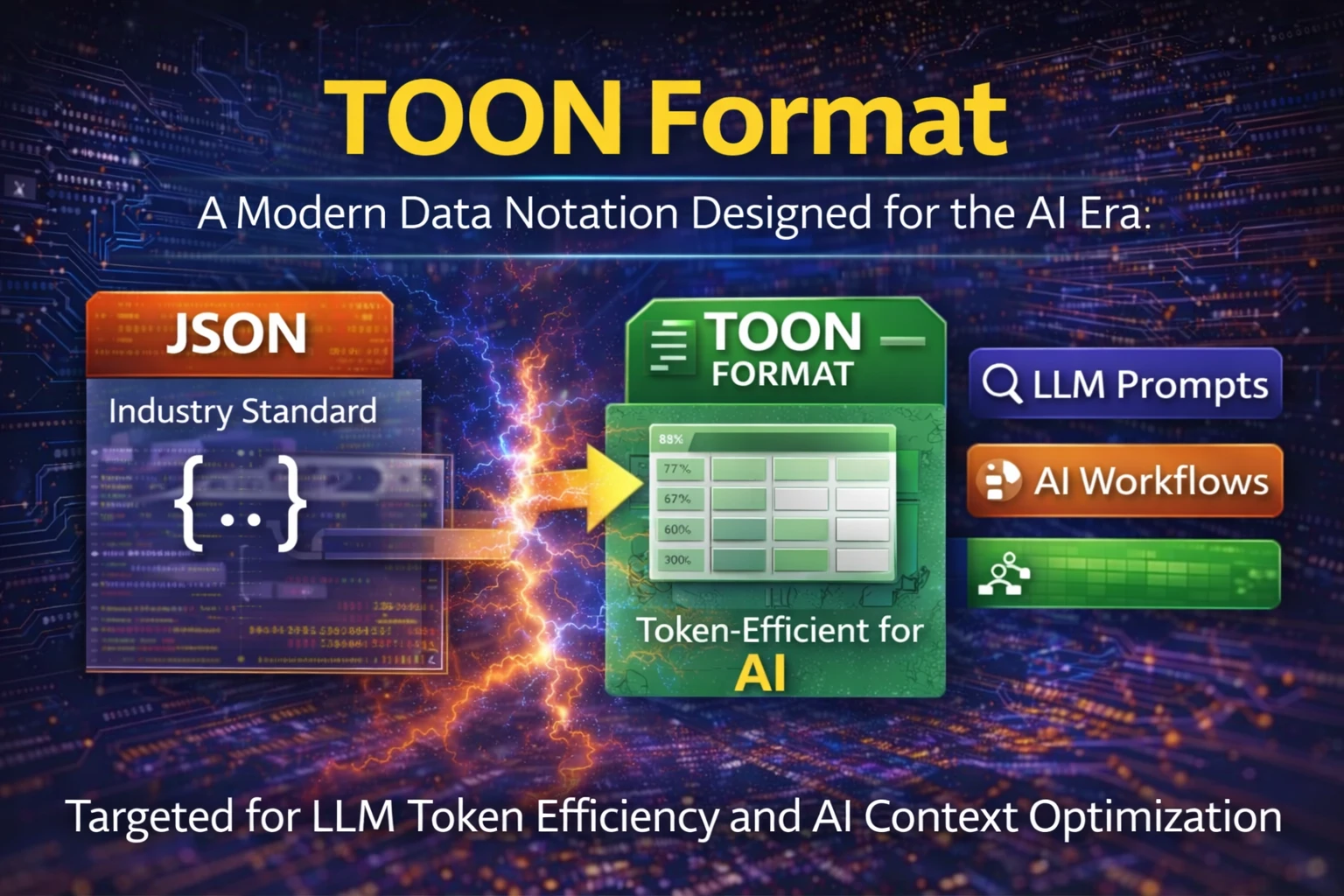
It is a structured data format designed to represent the same information as JSON, but using significantly fewer tokens. TOON achieves this by removing unnecessary syntax and focusing on patterns that are easier for language models to parse and reason about.
TOON supports:
- Objects
- Arrays
- Primitive values
- Nested structures
But it expresses them using:
- Indentation instead of braces
- Tabular layouts for uniform data
- Shared field definitions to avoid repetition
The result is a compact, readable, and LLM-friendly format.
Where Do We Use TOON?
TOON is not a replacement for JSON everywhere. Instead, it is designed for AI-focused workflows, such as:
- Passing structured datasets into LLM prompts
- Agent-based AI systems
- Prompt pipelines with large arrays or repeated objects
- AI orchestration layers where context size matters
- Cost-sensitive LLM applications
In traditional web APIs or browser-based integrations, JSON still remains the better choice. TOON shines specifically where tokens are the bottleneck.
Purpose of TOON
The core purpose of TOON is simple:
Represent structured data in a way that is efficient for language models.
JSON was designed for machines to parse reliably.
TOON is designed for models to understand efficiently.
By reducing repeated keys, punctuation, and structural noise, TOON allows:
- More meaningful data in the same context window
- Lower token usage
- Better prompt clarity
- Improved model accuracy in structured reasoning tasks
Pros of TOON
1. Token Efficiency
TOON can reduce token usage by 30–60%, especially when working with large arrays or uniform objects.
2. LLM-Friendly Structure
Explicit array sizes and field definitions act as guardrails, helping models reason about structure more reliably.
3. Clean and Readable
Despite being compact, TOON remains readable to humans, especially developers familiar with structured data.
4. Lossless Conversion
TOON can be converted to and from JSON without losing information, making it safe for structured workflows.
5. Designed for Modern AI Systems
TOON is built with real AI constraints in mind — context limits, token costs, and reasoning accuracy.
Cons and Limitations
1. Not a Universal Standard
JSON has decades of ecosystem support. TOON is still evolving and not yet universally adopted.
2. Learning Curve
Developers need time to get comfortable with TOON’s syntax and mental model.
3. Best for Uniform Data
For deeply irregular or highly nested structures, JSON can sometimes be more compact.
4. Limited Use Outside AI
TOON is not intended for REST APIs, browser configs, or general-purpose storage.
JSON vs TOON – A Practical Comparison
| Aspect | JSON | TOON |
|---|---|---|
| Primary Goal | Universal data exchange | Token-efficient AI communication |
| Syntax | Braces, quotes, commas | Indentation, minimal symbols |
| Readability | Familiar, verbose | Compact, structured |
| Token Usage | Higher | Significantly lower |
| Ecosystem | Mature and universal | Growing and AI-focused |
| Best Use Case | APIs, configs, storage | LLM prompts, AI pipelines |
Key takeaway:
JSON and TOON are not competitors. They solve different problems at different layers of modern systems.
Conclusion
As software systems evolve toward AI-first architectures, the way we represent data must evolve as well.
TOON represents a new category of data formats — ones that are designed for language models, not just parsers. It doesn’t aim to replace JSON everywhere, but where token efficiency, cost control, and prompt clarity matter, TOON offers a compelling alternative.
At FUEINT, exploring formats like TOON aligns with our focus on modern, scalable, and forward-thinking engineering practices. Understanding these emerging standards today helps us build smarter systems tomorrow.