

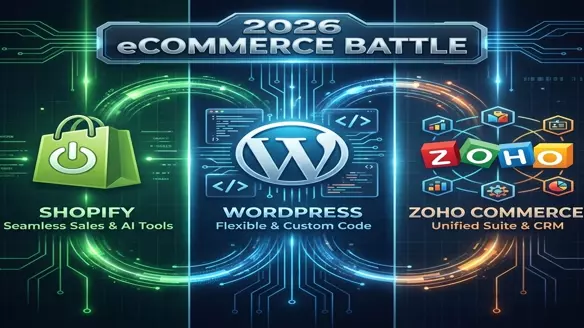
Shopify vs WordPress vs Zoho Commerce: What You Should Actually Use in 2026
Running an online store in 2026 isn't about whether eCommerce works—it's about choosing a platform that won't limit you later.
Most store owners don't fail because of marketing or products.
They fail because they picked a platform that:
- Became expensive to scale
- Couldn't support their workflows
- Required constant fixes and maintenance
- Locked them into a vendor's ecosystem
The three platforms most people compare are Shopify, WordPress (with WooCommerce), and Zoho Commerce.
They look similar on marketing pages. In reality? They solve very different problems.
This guide strips away hype and focuses on how these platforms behave in the real world—with actual numbers, honest tradeoffs, and decision filters you can use right now.
Quick verdict (read this first)
If you want the answer without the 12-minute read:
-
Choose Shopify if
- You want speed, stability, and minimal technical involvement.
- You plan to scale products, traffic, or countries aggressively.
- You accept higher monthly costs for peace of mind and zero maintenance.
- Your store has complex inventory, variants, or multi-channel needs.
-
Choose WordPress + WooCommerce if
- SEO, content strategy, and full code control are core to your growth.
- You need custom workflows, APIs, or integrations beyond standard eCommerce.
- You're comfortable managing hosting, uptime, and technical debt (or paying someone to).
- You want to own your data and hosting completely.
-
Choose Zoho Commerce if
- You already run your business on Zoho CRM, Books, or Inventory.
- You want predictable, low costs and fewer third-party dependencies.
- Your store requirements are straightforward (< 1,000 SKUs, standard flows).
- Regional support in India/localized markets matters.
The brutal truth: Trying to force one platform to behave like another is how teams waste thousands of dollars and months of time.
What each platform actually is (and isn't)
This section will save you from a lot of confusion.
Shopify: The hotel analogy
Think of Shopify like staying in a well-run hotel chain.
Shopify handles:
- The building (hosting)
- Electricity and water (infrastructure)
- Security (PCI compliance, backups, DDoS protection)
- Housekeeping (updates, patches, performance scaling)
You just manage the guest experience (your store).
What you get:
- Uptime guarantees (99.99%)
- Automatic scaling during traffic spikes
- Built-in SSL, backups, and security
- Checkout that's been tested with millions of transactions
What you give up:
- Custom server-level configuration
- Direct access to source code
- Ability to host multiple stores on one infrastructure
- Freedom to use any tech stack (you're on their infrastructure)
WordPress + WooCommerce: The house you own and maintain
WordPress is like owning a house.
You own:
- The building (hosting server)
- The plumbing (code)
- The electrical system (database)
- All customizations and extensions
What you get:
- Complete data ownership
- Unlimited customization (PHP, JavaScript, database)
- No vendor lock-in
- Ability to move hosting or integrate anything you want
What you give up:
- Someone else handling security patches
- Automatic scaling (you manage it)
- Built-in uptime guarantees
- Time for maintenance and debugging
Real cost: A developer who understands WordPress security is mandatory, not optional.
Zoho Commerce: The franchise model
Zoho Commerce works like joining a business franchise.
Zoho provides:
- The platform structure
- Built-in CRM, email, invoicing, inventory
- Regional support and localized payments
You provide:
- Your products and branding
- Operational processes
What you get:
- Everything integrated (orders sync to CRM automatically)
- Regional support in India, Middle East, and other markets
- Low costs with no transaction fees
- Simple operations with fewer tools to manage
What you give up:
- Design flexibility (limited themes, basic customization)
- Third-party app ecosystem (very small)
- Advanced customization (constrained to Zoho's design)
Core differences: side-by-side breakdown
| Dimension | Shopify | WordPress (WooCommerce) | Zoho Commerce |
|---|---|---|---|
| Hosting Model | Fully hosted (SaaS) | Self-hosted (you manage) | Fully hosted (SaaS) |
| Setup Time | 2-4 hours | 3-7 days (with dev setup) | 1-2 days |
| Learning Curve | Easy (non-technical people can do it) | Steep (requires dev knowledge) | Easy-moderate |
| Monthly Cost | $29–$2,300+ (see pricing section) | $15–200 (hosting+plugins only) | $49–500 |
| Transaction Fees | 2.2% + 30¢ if not using Shopify Payments | Depends on payment gateway | 0% (included in plan) |
| Themes Available | 200+ modern themes | 5,000+ WordPress themes + custom dev | ~20 templates |
| Design Flexibility | Good (drag-drop + Liquid code) | Unlimited (full code access) | Limited (CSS editor + code injection) |
| Max Product Variants | 2,000 per product | Unlimited (via WooCommerce + custom code) | <100 per product |
| Inventory Locations | Up to 200 (Shopify Plus) | Unlimited (with correct setup) | Limited to basic multi-location |
| Payment Gateways | 100+ global providers + Shop Pay | 50+ plugins available | 20+ providers |
| App Ecosystem | 8,000–13,000 vetted apps | 60,000+ WordPress plugins | 50-100 Zoho-specific apps |
| SEO Control | Moderate (sitemaps, URLs, meta fields built-in) | Excellent (granular control via Yoast/Rank Math) | Moderate (basic SEO tools) |
| Blogging Capability | Yes, but basic | Yes, world-class (CMS + eCommerce) | Limited |
| Customization | Liquid templates + APIs | Full PHP/JS/database access | Dashboard only |
| Uptime SLA | 99.99% guaranteed | Depends on your host (usually 99.5%) | 99.9% |
| Support Type | Chat/email (no phone on lower tiers) | Fragmented (host + theme + plugins) | Phone support available, structured |
| Data Ownership | Shopify owns your data (can export) | You own your data completely | Zoho owns it (can export JSON) |
| Migration Difficulty | Easy in (hard out) | Easy in & out | Easy out but pain importing |
| Best for | Scaling fast, multi-channel, zero-maintenance | Content-heavy, SEO-driven, custom logic | Zoho-integrated businesses, simple stores |
If you're visual, this table is your entire decision filter right here.
Critical Feature Breakdown
1. Inventory & Product Management
- Shopify: Best for standard retail. Supports 2,000 variants/product and native multi-location inventory. Good for multi-channel sales (social, Amazon).
- WordPress: Infinite flexibility. Unlimited variants and custom workflows, but performance depends on hosting. Ideal for complex catalogs.
- Zoho Commerce: Good for simple needs. Strictly for <1,000 SKUs. Excellent sync with Zoho Inventory but weak variant management.
2. Payment Gateways
- Shopify: Global leader. Own payment rail (Shopify Payments) plus 100+ gateways.
- WordPress: Integrate anything (Stripe, Razorpay, etc.) via plugins.
- Zoho Commerce: Limited (~20 gateways). Strong in India/Middle East, weaker globally.
3. Ease of Use & Design
- Shopify: Fastest to launch (hours). Polished templates.
- WordPress: Steepest learning curve. Infinite design control but requires dev effort.
- Zoho Commerce: Middle ground. Easy to start, but rigid design.
4. SEO & Extensibility
- Shopify: Solid basics. Good apps for extensions (8,000+ apps), but they add monthly costs.
- WordPress: The SEO king. 60,000+ plugins. Best for content-heavy strategies.
- Zoho Commerce: Functional basics. Small ecosystem (~500 extensions).
Pricing & Total Cost of Ownership
I’ll break this down clearly, without hype, without padding, and with actual cost implications instead of vague marketing talk. I’ll also normalize pricing into monthly and annual amounts to make apples-to-apples sense.
1) Shopify Pricing (based on your screenshots)
| Plan | Yearly Price (₹ / mo) | Monthly Price (₹ / mo) | Approx USD/yearly (₹ / 83) |
|---|---|---|---|
| Basic | ₹1,499/mo | ₹1,994/mo | ~$18 |
| Grow | ₹5,599/mo | ₹7,447/mo | ~$67 |
| Advanced | ₹22,680/mo | ₹30,164/mo | ~$273 |
| Plus | ₹1,75,000/mo | ₹1,75,000/mo | ~$2,108 (annual term) |
Notes (straight from screenshot):
- Shopify gives ₹20 promo for first 3 months on monthly terms — trivial after promo.
- Higher plans mean better shipping & payment fees.
- The “Plus” plan is only available on 1-yr or 3-yr terms (enterprise tier).
Reality check:
- Shopify’s middle business tier (Grow) is not cheap once you factor in international fees.
- Apps (e.g., reviews, subscriptions, upsells) often add $50–$200/mo.
- If you don’t use Shopify Payments, you pay extra transaction fees.
2) Zoho Commerce Pricing (from your screenshots)
Monthly billed yearly
| Plan | ₹ / mo | Approx USD/mo |
|---|---|---|
| Standard | ₹599/mo | ~$7 |
| Professional | ₹1,799/mo | ~$22 |
| Premium | ₹3,999/mo | ~$48 |
Monthly billed monthly (no annual discount)
| Plan | ₹ / mo | Approx USD/mo |
|---|---|---|
| Standard | ₹999 | ~$12 |
| Professional | ₹2,999 | ~$36 |
| Premium | ₹6,999 | ~$84 |
Key realities:
- Zoho Commerce includes hosting, SSL, store platform, products, CRM integrations.
- No transaction fees (your payment gateway still may charge fees).
- The plans are significantly cheaper than Shopify at equivalent capability.
3) WordPress + WooCommerce (generic market rates)
You didn’t upload specifics for this — so I’ll give typical real-world costs:
| Cost Component | Typical Range |
|---|---|
| Hosting (managed) | $15–$50/mo |
| Domain | ~$10–$20/yr |
| SSL | Free (Let’s Encrypt) |
| WooCommerce | Free core |
| Premium theme (e.g., Divi) | $89/yr or $249 one-time |
| Page builder (Elementor Pro) | $59–$399/yr |
Quick total cost (developer built) — ballpark
- Hobby store: ~$20/mo hosting + $89 theme = ~$329/yr
- Agency level: ~$40/mo hosting + $199–$399 plugins = ~$680–$880/yr
If you DIY it, your cost is mostly hosting + software. If you hire developers each year, add dev retainer or maintenance (~$500–$3000+/yr).
Reality Verdict
| Platform | Typical Annual Cost | Best Fit |
|---|---|---|
| Shopify | $1,200–$3,400+ | Fast launch, managed commerce, lots of built-in features |
| Zoho Commerce | $400–$1,200 | Budget ecommerce, low fixed cost, less versatile |
| WordPress + WooCommerce | $800–$4,000+ | Maximum control, lower base cost but high maintenance |
Real-world scenarios: which platform for what?
- Local boutique ($800k rev): Shopify. Handles POS and social selling easily.
- Content-driven brand ($5m rev): WordPress + WooCommerce. Essential for custom data & SEO architectures.
- Service business using Zoho: Zoho Commerce. Best for unified billing and CRM.
Scaling reality: what breaks first?
Shopify scaling limits
- Operational: Shopify can handle unlimited orders (literally)
- UX/design: At $5m+, you might want more customization (headless options available)
- Costs: App ecosystem becomes expensive
- Workaround: Shopify Plus ($2,000+/month) for enterprise needs
WordPress scaling limits
- Technical: Needs strong DevOps/infrastructure team
- Complexity: More plugins = more conflicts, security surface
- Performance: Requires ongoing optimization as traffic grows
- Team: Needs dedicated developer support
- Workaround: Headless WordPress + dedicated servers
Zoho Commerce scaling limits
- Hard ceiling: Around 50–100k orders/month before platform feels sluggish
- Feature: Product catalog limited to ~2,000 SKUs practically
- Integrations: Limited ecosystem for advanced tools
- Team: Works for small teams, not enterprise
- Workaround: Transition to Shopify or WooCommerce (migration possible)
Migration & switching costs
Switching from Shopify to WordPress
- Effort: 2–4 weeks with developer
- Cost: $3,000–$10,000 in development
- Data loss: Zero (if done correctly)
- SEO impact: Minimal (redirects managed)
- Downtime: Can be zero (planned migration)
Switching from WordPress to Shopify
- Effort: 1–3 weeks
- Cost: $2,000–$8,000 in migration service or dev
- Data loss: Possible if not careful with URLs/products
- SEO impact: Risk if 301 redirects not set up
- Downtime: Can be zero
Switching from Zoho to Shopify/WordPress
- Effort: 1–2 weeks
- Cost: $1,500–$5,000
- Data loss: Low risk
- SEO impact: Minimal
- Downtime: Can be zero
Reality: Switching platforms is possible but disruptive. Get it right the first time.
Final decision matrix
| Question | Answer → Platform |
|---|---|
| Do I need the store live THIS WEEK? | Shopify |
| Is SEO/content my main growth lever? | WordPress |
| Am I already using Zoho for my business? | Zoho Commerce |
| Do I have $500+ SKUs with lots of variants? | Shopify or WordPress |
| Is my team non-technical? | Shopify |
| Do I need deep customization? | WordPress |
| Do I want lowest operational overhead? | Shopify |
| Do I want lowest transparent costs? | Zoho |
| Am I building an authority brand with content? | WordPress |
| Will I sell in 20+ countries? | Shopify |
The Conclusion
There's no "best" platform. There's only the best platform for your specific situation right now.
- Shopify wins on convenience and reliability. You trade flexibility for speed.
- WordPress wins on control and SEO. You trade convenience for power.
- Zoho wins on integration and cost when you're already in the ecosystem. You trade features for simplicity.
Pick based on:
- Your technical comfort level
- Your growth ambitions
- Your current budget
- Your content/SEO strategy
Get it right from the start. Switching platforms later is expensive and painful.