

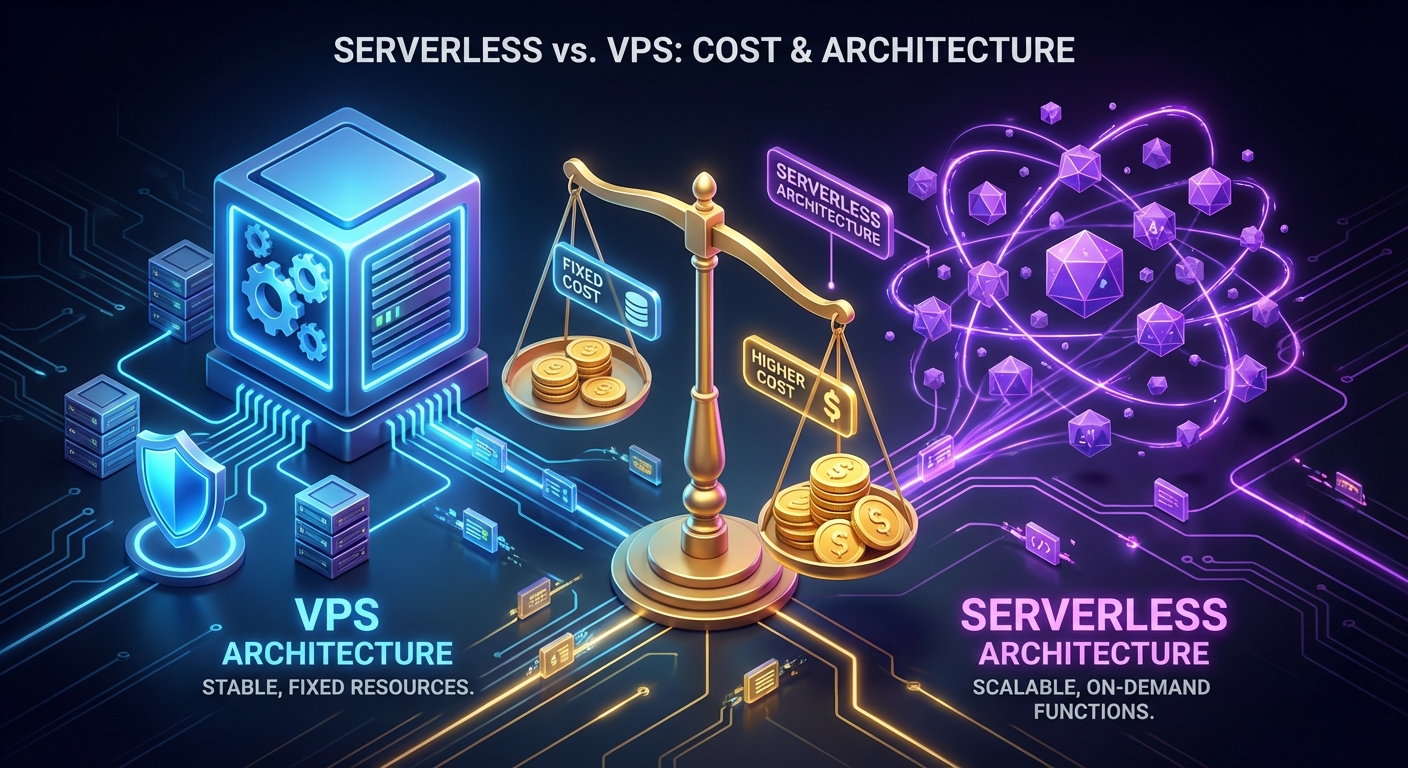
The Serverless Myth of “Cheap” Scale
For years, serverless architectures (AWS Lambda, Vercel Functions, Cloudflare Workers) have been marketed with a compelling promise: “You only pay for what you use.” This model is incredibly attractive for startups and teams looking to minimize operational overhead—no servers to manage, no patching, and automatic scaling.
However, as applications mature and traffic scales, many engineering teams encounter a harsh economic reality: the pay-as-you-go model can become significantly more expensive than a fixed-cost VPS or container cluster.
This article is not an argument against serverless. Instead, it offers a pragmatic, numbers-driven analysis to help you determine when serverless is the right tool—and when a traditional server is the smarter financial choice.
Table of Contents
- Defining the Architectures: Serverless vs. VPS
- The Cost Model: Execution vs. Capacity
- The Crossover Point: When the Bill Flips
- Where Serverless Shines
- When VPS is the Superior Choice
- Hidden Costs: Beyond the Monthly Bill
- Decision Framework for 2026
- Conclusion
- Resources
Defining the Architectures: Serverless vs. VPS
To understand the economics, we must first clarify the technical models.
Serverless (Function-as-a-Service)
When we discuss "serverless" in this context, we refer to FaaS platforms like:
- AWS Lambda, Google Cloud Functions, Azure Functions
- Edge functions on Vercel, Netlify, or Cloudflare
Billing Model: You pay for invocations (number of requests) and execution duration (GB-seconds). If your code isn't running, your cost is near zero.
VPS (Virtual Private Server)
A VPS represents a provisioned virtual machine, such as:
- DigitalOcean Droplets, Hetzner, Linode, or fixed EC2 instances
- Containerized workloads running on these VMs (Docker/Kubernetes)
Billing Model: You pay a flat monthly fee for reserved capacity (vCPU, RAM, Disk), regardless of whether the server is 100% utilized or idle.
The Cost Model: Execution vs. Capacity
The fundamental economic trade-off can be summarized as follows:
| Model | You Pay For | Ideal Use Case |
|---|---|---|
| Serverless | Granular execution time | Spiky, unpredictable, or low-volume traffic |
| VPS | Reserved compute capacity | Steady, predictable, high-volume traffic |
Think of it like transportation:
- Serverless is like a ride-share service (Uber/Lyft). It's convenient and cheap for occasional trips, but expensive if used for a cross-country commute every day.
- A VPS is like leasing a car. You have a fixed monthly payment. If you drive it 24/7, the cost per mile is incredibly low. If it sits in the garage, you're wasting money.
The Crossover Point: When the Bill Flips
Let’s look at a concrete example to identify where the costs diverge.
Scenario: An API endpoint that processes requests.
- Resources: 512 MB Memory
- Duration: ~200 ms per request
We compare a standard Serverless function against a modest $18/month VPS (2 vCPU / 2 GB RAM).
| Monthly Requests | Approx. Serverless Cost | VPS Cost (Fixed) | Winner |
|---|---|---|---|
| 100k | ~$0.25 | $18.00 | Serverless |
| 1M | ~$2.50 | $18.00 | Serverless |
| 10M | ~$25.00 | $18.00 | VPS |
| 100M | ~$200.00+ | $18.00 - $40.00 | VPS |
The Insight: At low to medium traffic, serverless is negligible in cost. However, as you cross into millions of requests, the VPS becomes significantly more economical.
[!NOTE] These calculations are estimates. For precise modeling, consult tools like this Lambda Cost Calculator or this detailed EC2 vs Serverless Analysis.
Where Serverless Shines
Despite the potential for high costs at scale, serverless remains the superior choice for specific workloads.
1. Spiky or Sporadic Traffic
If your application has long periods of silence followed by sudden bursts (e.g., ticket sales, marketing campaigns), serverless handles the scaling automatically without you paying for idle servers.
2. Event-Driven Automation
For background tasks that trigger asynchronously—processing file uploads, handling webhooks, or running scheduled cron jobs—serverless is unbeatable. You avoid the operational burden of maintaining a dedicated server for tasks that run only a few times a day.
3. Rapid Prototyping (MVPs)
When speed-to-market is the priority, serverless allows developers to ship code without configuring infrastructure. The initial higher cost per request is often outweighed by the savings in DevOps time.
When VPS is the Superior Choice
As your application matures, "renting" capacity becomes less efficient than "owning" it.
1. High, Predictable Baselines
If your API handles a consistent stream of requests 24/7, paying for execution time is like paying "retail" rates for compute. A VPS offers "wholesale" pricing for dedicated access to CPU and RAM.
2. Compute-Intensive Workloads
Tasks requiring significant CPU or Memory—such as AI inference, video transcoding, or complex data processing—can be prohibitively expensive on serverless due to the direct correlation between resource usage and cost. See this analysis on high-compute serverless costs.
3. Low-Latency Requirements
Serverless functions can suffer from "cold starts"—the delay when a function initializes. A VPS keeps your application loaded in memory, ensuring consistent, low-latency responses for every user.
Hidden Costs: Beyond the Monthly Bill
Total Cost of Ownership (TCO) involves more than just the invoice from AWS or DigitalOcean.
Developer Productivity vs. Optimization
With serverless, engineers often spend valuable time optimizing for the platform—fighting cold starts, managing bundle sizes, and working around timeouts. This is engineering time that could be spent building features.
Vendor Lock-In
Serverless architectures often couple your code tightly to a specific provider’s triggers and services. Migrating a complex serverless backend to another provider or a containerized environment can be a costly re-engineering effort. Standard VPS/Container setups typically use open standards (Docker, Linux, NGINX), making them more portable.
Decision Framework for 2026
Use this guide to choose the right architecture for your next project.
Choose Serverless If:
- Traffic: Unpredictable, spiky, or currently low.
- Workload: Event-driven (webhooks, file processing), cron jobs.
- Team: Small, focused on product features, limited DevOps capacity.
- Goal: Maximum development speed and minimal operations.
Choose VPS / Containers If:
- Traffic: Consistent, high-volume baseline.
- Workload: Core API, long-running processes, heavy computation.
- Team: Comfortable with basic infrastructure management (Docker, CI/CD).
- Goal: Cost predictability and maximum performance per dollar.
The Hybrid Approach
The most effective architectures often combine both. Use a VPS/Container cluster for your core, always-on API and database, and offload specific, bursty tasks to Serverless functions. This gives you the stability of fixed pricing with the elasticity of the cloud.
Conclusion
Serverless is a powerful tool, but it is not a universal solution. For early-stage startups and specific event-driven tasks, the pay-as-you-go model is a financial and operational win. However, for mature products with steady load, a well-optimized VPS or container setup remains the gold standard for performance and cost efficiency.
By understanding the economics behind the hype, you can make architectural decisions that scale with your business—without breaking the bank.
Resources