

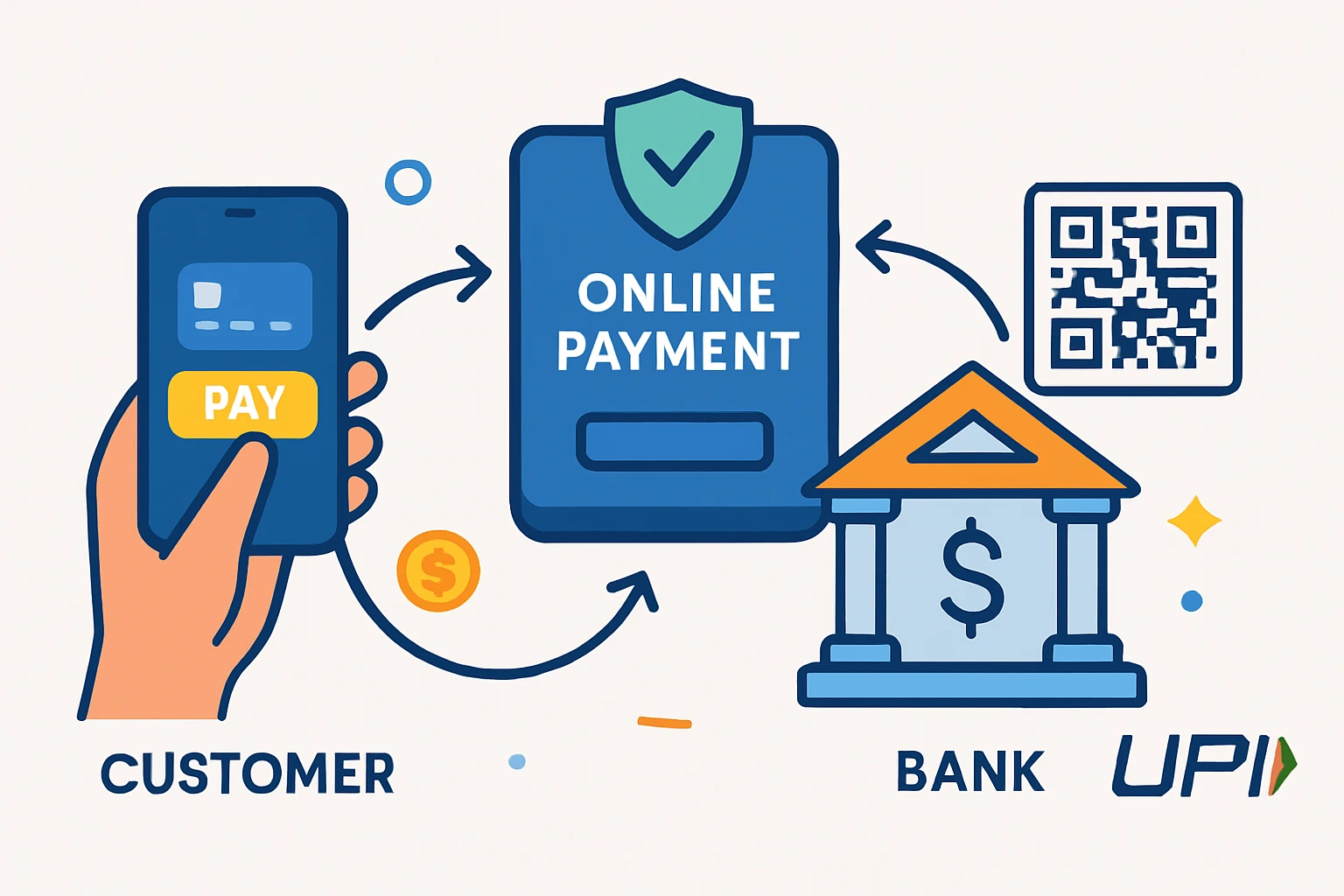
In today’s digital world, online payments happen seamlessly when you shop on websites or pay through apps. But have you ever wondered how payment systems like Razorpay or Stripe actually work behind the scenes to connect your money with a merchant’s bank account? This blog breaks down the process in simple terms and explains the complexities involved if someone wanted to build such a system on their own.
What is a Payment Gateway?
Think of a payment gateway as a secure digital bridge between you (the customer) and the merchant’s bank. When you make a payment online using a credit card, debit card, or UPI (Unified Payments Interface), the payment gateway makes sure your sensitive payment information is safely transmitted, verified, and the money is moved correctly.
Step-by-Step: How Payment Gateways Work with Banks and UPI
1. Initiating the Payment
You select what to buy on a merchant’s website or app and proceed to checkout. You enter your payment info—like card details or UPI ID.
2. Securing Your Payment Data
Once submitted, the payment gateway encrypts your payment details. This encryption scrambles your information so hackers can’t steal it during transmission.
3. Sending Data to Payment Processors and Banks
The encrypted info is sent to the merchant’s payment processor and acquiring bank. The acquiring bank is the merchant’s bank that will receive the payment.
4. Authorization Request
The acquiring bank forwards the transaction request to the card network (such as Visa, Mastercard, or Rupay) or directly to the issuing bank (your bank that issued your card or UPI handle).
5. Verification and Approval
Your bank checks whether your account has enough funds or credit, validates your identity (sometimes asking for OTP or PIN), and decides whether to approve or decline the transaction.
6. Communicating the Result
The approval or decline message is sent back through the same chain—from your bank to the card network, to the acquiring bank, then the payment gateway, and finally to the merchant’s website or app.
7. Completion and Settlement
If approved, the merchant is notified and can fulfill your order. The banks then settle the funds, moving money from your account to the merchant’s account within a timeline (usually within a few business days).
How Does UPI Fit In?
UPI is an India-specific instant payment system that allows customers to pay merchants using just a Virtual Payment Address (VPA) or QR code. Payment gateways like Razorpay or Stripe support UPI payments by:
- Generating UPI QR codes or collecting VPAs.
- Handling UPI mandates and transaction verification according to NPCI guidelines.
- Settling funds to merchant bank accounts via NEFT or IMPS, all while abstracting the technical complexities for you and the merchant.
What If You Want to Build Your Own Payment System?
Building a payment gateway involves significant technical, operational, and legal challenges:
- Bank Partnerships: You need formal agreements with banks to access their systems and accounts.
- Regulatory Compliance: Compliance with financial regulations, anti-fraud, AML (Anti-Money Laundering), and KYC (Know Your Customer) is mandatory.
- Access to APIs: Direct APIs for UPI and banking systems are not publicly available. You must become an authorized PSP (Payment Service Provider) and partner with banks and institutions like NPCI (in India) to gain access.
- Security and Infrastructure: High standards of data encryption, transaction security, PCI DSS compliance, and system reliability are required.
- API Design and Management: You’ll need your own APIs for order creation, payment processing, payouts, refunds, notifications, and reconciliation.
Due to these complexities, most businesses use existing payment gateways like Razorpay or Stripe that provide easy-to-use APIs to handle all of this for them.
This blog gives an overview anyone can understand about how money flows securely from customers to merchants through online payments, and why building such systems requires major contributions from banks, regulators, and technology providers.